

The people who actually create translation systems began discussing their own work in a different way around 2017. Words from the previous vocabulary, such as “alignment,” “phrase tables,” and “n-grams,” started to disappear from the discussion. Another thing moved in. vectors. tensors. weights for attention.
The change was subtle but genuine, and it was accompanied by a silent acknowledgement that the machines were no longer translating words by word. They were acting strangely, more like they were sensing the structure of a sentence before creating the next one.
| Field | Details |
|---|---|
| Subject | The Mathematics of Machine Translation |
| Field of Study | Computational Linguistics, Neural Networks, Applied Mathematics |
| Core Disciplines | Linear Algebra, Calculus, Probability Theory |
| Notable System | CUBBITT (Charles University Block-Backtranslation-Improved Transformer Translation) |
| Landmark Achievement | Outperformed professional human translators on English–Czech news task at WMT 2018 |
| Foundational Paradigm Shift | Rule-based → Statistical → Neural Networks |
| Key Architecture | Transformer models with attention mechanisms |
| Academic Reference | Northeastern University graduate course on Text Information Processing |
| Primary Evaluation Metrics | Translation adequacy, fluency, BLEU score |
| Current Frontier | Context-aware translation across full documents |
It’s difficult to ignore how much of this revolution is based on math, which at first glance seems to have nothing to do with language. The foundation of contemporary translation turns out to be linear algebra, the kind taught in sophomore lecture halls with chalkboards covered in matrices. Meaning begins to behave geometrically as words are forced into high-dimensional spaces with hundreds of coordinates per term. The well-known example, “King minus Man plus Woman lands somewhere near Queen,” seems like a ruse. It isn’t. It’s the entire game. You can train a model to understand relationships that no one bothered to record once you can perform arithmetic on meaning.
Charles University researchers demonstrated the limits of this geometry. When their CUBBITT system was evaluated blindly against expert human translators using English-to-Czech news articles, it accomplished something that most experts in the field thought would take years.
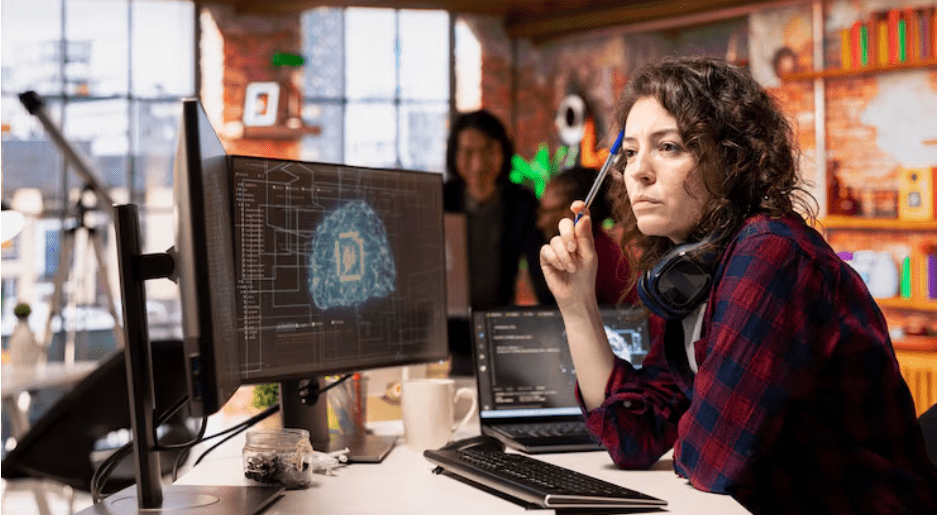
It was more accurate than humans at communicating meaning. The judges still preferred the human cadence, but the machine outperformed it in terms of raw adequacy and maintaining the meaning of the original sentence. In a translation Turing test, the majority of participants were unable to accurately identify which version originated from an individual.
Beneath all of this, calculus does the heavy lifting. Fundamentally, training a neural translation model involves hiking through a billion-dimensional terrain in search of valleys. The algorithm that looks is called gradient descent, and it is slow, unromantic, and sometimes stuck. However, if you run it long enough on enough data, the loss function flattens, and all of a sudden the system is producing fluent French instead of word salad. When I speak with engineers who work on these systems, I get the impression that they are just as shocked by how well they function.
The remaining weight is carried by probability theory. Technically, each translation a model generates is an estimate of the most likely order of tokens in the target language given the source. In 2016, Google Translate became readable thanks to a trick called the attention mechanism, which is simply a clever way of weighing which parts of the source sentence matter most when generating each word of the output. It’s elegant mathematically. From a practical standpoint, it’s the difference between something that reads almost like prose and a tourist phrasebook.
The question of whether any of this qualifies as understanding remains unanswered. These days, the systems manage context in ways that would have been unthinkable ten years ago, but they make strange mistakes, misinterpreting sarcasm, and mispronouncing pronouns in lengthy passages. Machines are remarkably close to the boundary thanks to the math. The question that the next generation of researchers will have to deal with is whether they cross it or if the boundary itself was a human concept all along.
